Thursday, September 26, 2013

The First Day of the New Regime


Mount St. Helens in Skamania County, Washington,
in the Pacific NW region of the United States,
before its 1980 eruption.

(Continued from last Thursday, September 19 . . . )
First, thank you for wishing me good health. As you can see, I just needed to go back to bed yesterday. Now I’m hunky-dory!
         Let’s continue this Omaha saga. In my memory, it’s Monday, February 15, 1960. I’ve come into the classroom and announced the method of discipline that would set boundaries for the rest of the school year. I began with the following words: “For four weeks, I’ve given you so much rope you’ve hanged yourselves with it.”
         I remember those words well. They helped me save face but were so untrue. I’ve given them no rope. The truth was I simply didn’t know how to establish classroom discipline in that milieu.
         To teach, I needed quiet punctuated by questions, curiosity, and discussion. Many of these seventh graders also wanted this, so my despotic discipline was unfair to them. But to reach the gang members and a couple of girls who were causing the disturbances, I had to become autocratic.          
         I also knew that the subtraction problems I meant to use for discipline would be wearisome to finish. To begin the process, I’d multiple a three-digit number like 537 by another three-digit number like 241. The answer would be 129,417.
         The students would then subtract 537 from this large number and would keep subtracting 537 until they got to 0. They’d subtract 241 times to do that. A lot of mental work.
         I explained this to the students to give them a sense of the scope of what staying after school meant. Several booed and let me know that no one—Absolutely. No. One.—could keep them after school to do anything.
         It was then I pulled my trump card.
         When Sister Brendan, the principal, had given me permission to try this tactic, she’d added, “Tell them that if they walk out and don’t complete the problem, they’ll be suspended for three days. And if they do that a second time, they’ll be expelled. That ought to do it.”
         When I played the trump card she’d given me, several boys cursed.
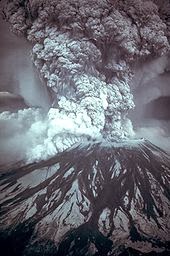
Eruption of Mount St. Helens on May 18, 1980, at 8:32 PDT.

         Hearing the curses from several students, I turned my back on the class—fearful still that someone might throw a knife—and printed their names on the chalkboard with a checkmark after each name.
         Turning back toward them, I said, “That’s for cursing. If you get two more checkmarks today, you’ll stay after school.” They groaned but said no more.
         To begin our new regime, I established a daily subject schedule. We’d pray, say the pledge of allegiance, and begin with religion. Following that, we’d study math, then reading, and so on.
         Before we began each subject that day, I distributed the textbooks for it and directed the students to open them to a section where their knowledge was weak. I’d learned their subject deficiencies from the quizzes I’d given on my first day in that classroom.
         As the day progressed, several boys sat like convulsive volcanoes ready to erupt. Throughout the day, I added checkmarks for anything that was on the list I’d posted that morning.


Mount St. Helens two years after the 1980 eruption.

         As I remember, by the day’s end, four boys—Ron, Bill, John M., and Tommy—and one girl—Jenny—had three or more checkmarks by their names. The five of them stayed after school. And subtracted. And subtracted. And tried to convince me they’d gotten to 0. And subtracted some more. The last student left the classroom nearly two hours after school ended. Fortunately, all five lived close by and could walk safely home.
         And so began the reign of Sister Innocence, tyrant of Mount Saint Scholastica Monastery.


Mount St. Helens, October 2009, 
with a view of the ice-covered crater rim.

(. . . to be continued next Wednesday, October 2)

Wednesday, September 25, 2013

I Hope to Be Back Tomorrow


(Continued from Thursday, September 19 . . . )
Hello All, on this sun-lit day here in Missouri. I'd planned on posting another story today about teaching in that seventh-grade classroom in Omaha, Nebraska, back in 1960. However, while the story is in my memory, waiting to be told, I'm a little under the weather today and my mind can’t tell a story with any assurance. So I'm going back to bed. 
         If all goes well, I'll post tomorrow. I want to explain why the gang members stayed after school when I said they had to.
            Have a good day. Peace.
                                                (. . . continued tomorrow, September 26.)

Thursday, September 19, 2013

The Omaha Denouement—Finally!


(Continued from yesterday, Wednesday, September 18 . . . )

Toward the end of the four weeks between January 18 and February 15, 1960, I began to think that if I became a pal to the seventh graders in our Omaha classroom they’d like me and want to learn.
         I discovered how mistaken that notion was on Friday, February 12, when we had a Valentine’s party. Besides bringing cupcakes, soda pop, and candy, several students also brought radios to the classroom. The party began in early afternoon. What ensued is like a Hieronymus Bosch painting.


Allegory of Gluttony and Lust by Hieronymus Bosch

         First, the students had a contest to see who could throw a cupcake up to the ceiling and make it stay. The contest continued an interminable time with much hooting and raucous laughter. Soda pop fizzed on the floor and against the windows. Girls ran around the room, trying to evade the groping hands of the boys.
         Then, several boys came to the front of the room, threw themselves on the floor, and turned up the volume on their radios. Moving their bodies suggestively, they humped, thrust, moaned. I stood by my desk as they performed their obscene floor dances just a few feet from me. They fixed their eyes on me and smiled with glee at my discomfort.
         That Friday-afternoon party was an ending for me. I knew I couldn’t go back into that classroom on Monday. That evening, my body must have proclaimed my great weariness—I’d lost ten pounds—and my despair and desperation. I say this because of what happened next.
         Sister Nicole, in whose fifth-grade classroom I’d substituted the first two weeks of January, was now home from the hospital. When she asked me how things were going, the whole sorry tale came pouring out.
         “We’ll put a stop to that,” Nicole said.
         “But how?” I could see no happy ending.
         “Here’s how. It’s this or Council Bluffs.” Nicole laid out the following plan: On Monday, I’d go into the classroom and announce a new beginning. I’d read a list of what I’d no longer tolerate:
1.    Interrupting my teaching
2.    Interrupting the responses and questions from others
3.    Jabbing with math compasses
4.    Throwing papers and books
5.    Spitting
6.    Making rude and obscene remarks
7.    Getting up from desks without permission
8.    Visiting other desks without permission
9.    Talking without permission
10. Failing to do homework
11. Sassing
The list must have had at least twenty-five unacceptable behaviors.
“The next thing you’ll do on Monday,” Sister Nicole said, “is to explain the punishment system.” What we devised is this:
·      Every time a student did something on the list, I’d put a check by his or her name on the chalkboard. At the end of the day, anyone who had three checks had to stay after school.
·     I’d give that student a subtraction problem by multiplying a three-digit number by another three-digit number. The student would then take the paper to his desk and begin. He’d subtract the second number—the subtrahend—from the first number—the minuend. He’d keep subtracting until the difference was zero. He’d stay after school until the problem was completed to my satisfaction.
         “But how will I know he hasn’t cheated to get out of detention early?” I asked.
         “When he shows you his work. Check it by multiplying your second number by 10, 20, 30, 40 . . . and so on. Look for the resultant numbers among the subtrahends. Just look for numbers that end with zero. Most students start to fudge and make up numbers until they get to a final answer of zero. You can show them where their subtracting went askew and set them to working the problem again.”
         “This’ll work?”
         “Once the students discover just how long all that subtracting takes it will.”
         I worked a problem and saw what Nicole meant. Then I went to Sister Brendan to get permission to keep the students after school for as long as it took for them to do the subtraction correctly. I also needed permission to miss Vespers, the lengthy chanted psalms the nuns prayed together after school ended.
         Monday came. I announced the new beginning. Within a week life had settled to what became the norm for the rest of the school year. In the next posting I’ll describe the atmosphere in which the students and I lived until the end of May. Cold. Chilly. Bleak.
                                       ( . . . continued next Wednesday, September 25.)

Bosch painting from Wikipedia.

Wednesday, September 18, 2013

Police Enter the Classroom


(Continued from last Wednesday, September 18 . . . )


Cartoon courtesy of Fishducky.

Each weekday between January 18 and February 15, 1960, I entered a seventh-grade Omaha classroom. After the students and I said morning prayers and recited the pledge of allegiance, I’d try to teach. Many of them talked, shouted, sang, cursed, yelled across the room. Others, however, maybe as many as two-thirds of the fifty-five, leaned forward at their desks, attempting to hear my voice over the din.
         At least once a week, a policeman visited me after school, asking questions about the students in my classroom, several of whom were members of the gang terrorizing that area of Omaha. Ron, the gang’s leader, gave me a hard time each day. I’d first met him as he banged a fellow classmate’s head against the playground ice.
         “They can bruise every part of your body and not break a bone,” the policeman confided. “Every kid in this neighborhood’s frightened. No one’ll rat on ‘em. You gotta be careful, Sister. They’ll turn on ya. Right here in this classroom.”
         I thanked him for his advice but I’d learned on the third day in that classroom that I had to face the students at all times. On that day—Wednesday January 20—I was facing the chalkboard, my right hand raised and to the side as I wrote some tidbit of knowledge. I heard a zing and then a thud.
         A quivering knife embedded itself about an inch from my little finger. My hand started trembling.
         The room was ominously silent as I turned and looked at that sea of faces. Some bore horror; others, triumph; still others, scorn.
         Given that the knife had zinged right past my hand, I thought it must have come from a boy in the row behind me. But no one looked guilty. Everyone just seemed interested in what I’d do.
         My hand still trembling, I pulled out the knife. Carried it with me to the door. Left the room. Crossed the hall to Sister Brendan’s room. Knocked.
         When she came to the door, I handed her the knife and explained what had happened. “Have all the students empty their pockets and purses on their desks. Then confiscate any weapons,” she said. “I want you to stand by your classroom door each morning from now on. Have the students empty out their pockets and handbags before coming into the room. Give any weapons to me.”
         I did this for the rest of the school year.
         During those early weeks, I had one proof-positive experience of what the policeman had tried to explain to me. After school one day, James stayed to ask what he needed to study to get into college. Not knowing the Nebraska colleges, I offered to talk with the other nuns that evening and get some information for him.
         The next day, I noticed that he moved gingerly in his desk as if in pain. When the other students filed out at the end of the day, I said, “James, you’re moving like you’re hurt. Has something happened?”
         He stood silent as if not sure what to say. Slowly he drew up his T-shirt. Dark bruises covered his entire chest and back. Deep purple bruises on top of bruises. Despair filled his dark eyes.
         “Who did this to you?”
         “The guys. In the gang.”
         “Why?”
         “They thought I was snitching on them when I stayed after school. Yesterday. So they ganged up on me.”
         “Will you tell this to the police?”
         He shook his head vehemently. “That’d land me in the hospital. Ron won’t be so easy on me next time.”
         And that was that. I was powerless to help him.
                                    (. . . continued tomorrow, Thursday September 19.)

NOTE: I don’t want to hold you in suspense any longer as to how and why things changed in that Omaha classroom. So tomorrow—Thursday—I’ll tell that story.          

Wednesday, September 11, 2013

My Sojourn in the Asylum


(Continued from Wednesday, September 4 . . . )

The four weeks between my walking innocently into the seventh-grade classroom and my taking tyrannical control remain chaotic in my mind. Just this morning, in a final dream before waking, I experienced again the bedlam that was that classroom. I woke in an irrational panic at having to write about the experience.
         Each school day for four weeks I entered that classroom filled with anxiety, knowing that most students would refuse to listen to anything I said. Between January 18 and February 12 of 1960, total mayhem reigned supreme. Mine was a voice in the wilderness.


Battle of Gettysburg by Thure de Thulstrup

         From the daylong quizzes I’d given on our first day together, I discovered what the students did and didn’t know about all the subject areas of that year. I found topics I could teach from scratch; others I could supplement.
         On the second day I took from the classroom closet all the books their previous teacher had collected right before Christmas. All the while, I wondered why she’d gone through the textbooks so quickly and what she’d planned to do with the students for the remainder of the year.
         As I distributed the books, many students threw them on the floor or sailed them through the air. They thudded against desks. Chalkboards. Windows. Students ducked while others yelled in pain when a book hit its target. I let them lie where they landed and tried to teach.


Battle of Gibraltar of 1607 by Cornelis Claesz van Wieringen

         I wanted to introduce a topic from one of the quizzes, ask the students questions about it, use their answers to ask other questions, get all the students involved, and relate the learning to their lives. In other words, I wanted to emulate the way I’d been taught by gifted teachers.
         A few students—both girls and boys—paid attention. Amidst the din, they leaned forward from their desks to listen.         
         What did the others do?
         They sang rowdy songs, painted their nails, practiced pitching a hardball, styled one another’s hair, played marbles on the floor.
         Ron and his gang started a game of poker, shouting their bets, stomping their feet, whooping. When the winner of each round slammed his palms down on his desk, the whole room quaked.


Battle of Waterloo 1815 by William Sadler

         By the end of that second day I felt distraught. At my wit’s end. Unglued. I sought out Sister Brendan, the principal as well as the superior at the convent. Haltingly, fearful that she’d send me back to the monastery in disgrace—the first nun in nearly 100 years who didn’t know how to teach—I recounted what had happened that second day. Her eighth-grade classroom was across from my seventh-grade one, so she must have heard the din of shouting and upheaval throughout the day, but I needed to ask for help.
         After listening intently to my sorry tale, Brendan said, “Sister Innocence, I could come into your classroom tomorrow and take control. But as soon as I walked out, you’d lose it again. They'll only feel contempt for you because they'll see you don't know what to do. They'll have won."
         “But what can I do to get control?” I asked. “Just tell me that. I’ve never taken an education course. What do I do?”
         “A classroom like yours isn’t covered in education courses,” she said. “You’re just got to figure this out on your own.” Then she told me not to talk about any of this with the other nuns. She didn't want to lower their morale or ruin my reputation. 
          I felt I'd already entered the madhouse.
                                             ( . . . continued on Wednesday, September 18)


Three paintings of battles from Wikipedia.