Thursday, October 9, 2014

Two Uncommon Cats and Therapy


My human, who’s huge on manners, suggests that I begin this purfect review by introducing myself. I’m dismayed that you don’t already have an appreciation of my ability to discern unspeakable nuggets from delectable tidbits.                                                                                                      
But such is the perfidy of a human who chooses to write about her past life. What’s interesting in that!?!?! It’s the present that matters. Yet, I’ve had to accept such cavalier treatment. Why? Quite simple—I enjoy the cushiness of her lap.                                                                                          
That’s settled then. Let us begin.                                                               
My name is Ellie. I wear brindle fur and, like my human, a little extra poundage. I remain up close and personal when she reads. I delight in sprawling—gracefully of course—on open books. Thus, when the time came to write this book review, I was the perfect fur person to do so.                                                                             
The book I’m encouraging you to read—with my most melodic yowls—is Purr Therapy by Dr. Kathy McCoy. A psychotherapist, she is the author of the popular and helpful blog “Dr. Kathy McCoy: Living Fully in Midlife.”                                   
As an objective reviewer, I may assure you that she is a true lover of felines and their foibles. She appreciates us, unlike some I could mention.                                                                                  
Observing us closely, she found, entirely by chance, two of us who were—trust me on this—quite exceptional: Timmy and Marina. Their names are in the subtitle to the book: What Timmy and Marina Taught Me About Life, Love, and Loss.                                                        
Timmy
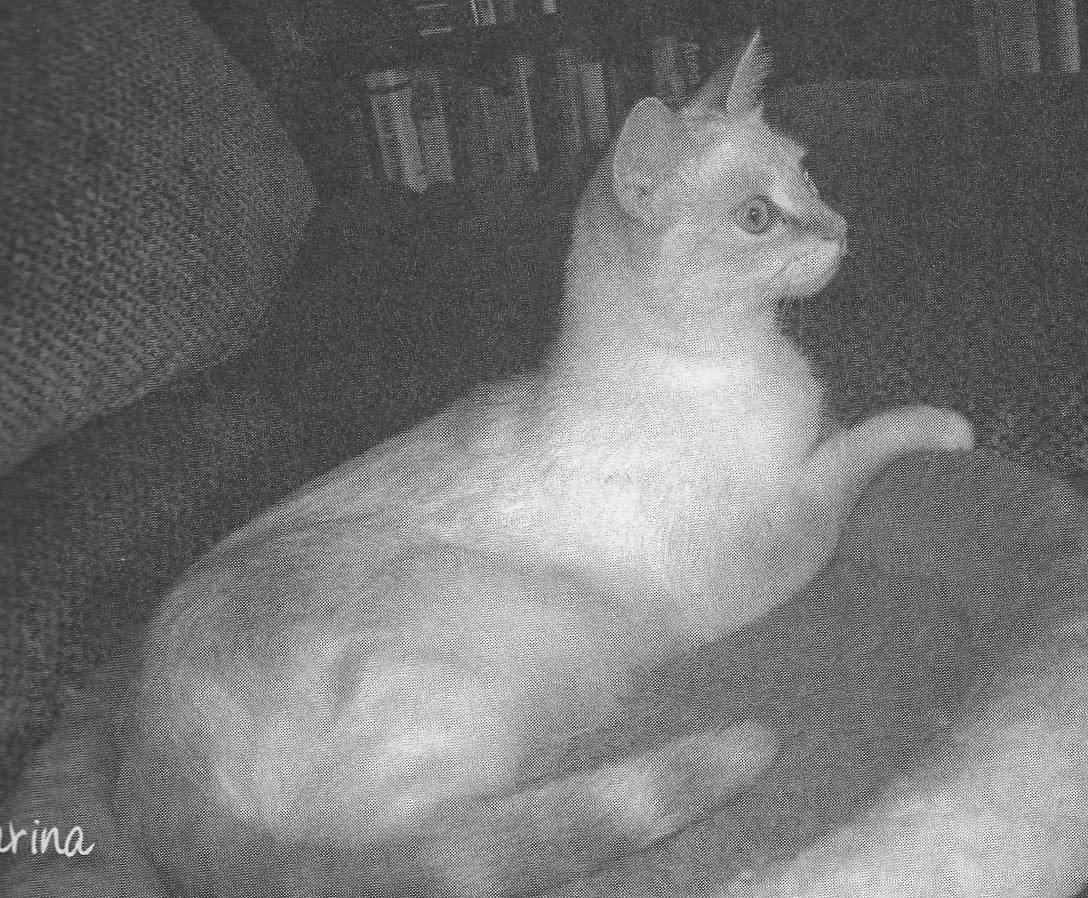
Marina
Why are these two so unusual? Because they refuse to exhibit those supposed traits that have sullied the reputation of felines. That is, being: Aloof. Destructive. Disdainful. Naughty. Picky. Sneaky. Stingy with our canned tuna.                                                       
Ever so delicately, Timmy and Marina shred those malicious rumors into mincemeat. That’s what makes McCoy’s book about them so appetizing.                                                                        
The following excerpt begins Purr Therapy. It provides an overview of just how uncommon those two cats were as they helped their human in her work of counseling others. Believe me it takes a peerless cat to know one and I tell you that they make me proud to be a feline.


Timmy and Marina never knew each other. But they were both rescue animals, both coming into my life when I wasn’t looking for a cat. And they both unexpectedly demonstrated traits that cats don’t often have—most notable an affinity for family, friends, and strangers. . . .
Cats aren’t frequently used in animal-assisted psychotherapy. This type of therapy cat, after all, needs to be friendly with strangers, willing to be touched, petted, and held by a variety of people unfamiliar to it. Therapy cats have to be tolerant of loud voices and angry shouting, emotional distress, and sudden movements. It’s a tall order for any creature, but it is a particular challenge for a cat. . . .
Knowing, loving, and working with both of these therapy cats was an incredible pleasure. Timmy and Marina brought comfort to my patients and joy to my home,
They had something else in common: they both died tragically, quite early in life, like angels lent for just a limited time. And yet, in their sweet, short lives, they made such a difference.
This is their story—and mine as I worked with, lived with, and loved these two very special cats, learning lessons in life, loss, and love along the way.

 In Purr Therapy you will learn how Timmy and Marina helped Dr. McCoy’s patients. I know my purrs comfort my human. I’m her “purr therapy.” But never could I cheer or console strangers—especially if they raised their voices.                                            
With the wisdom with which my race has endowed me, I encourage you to read about these two extraordinary felines and the human who recognized their gifts. That trio—Timmy, Marina, and Dr. McCoy—have been a gift from the Universe to all their patients and now to me and my human and . . . to you.                 
As that human of mine would say, “Peace.” 


Thursday, October 2, 2014

A Day in the Life Of


This morning I’ve been here in my office lined with bookshelves that provide background reading on Bronze-Age Greece, theology, felines, and the Judaism of ancient Palestine. In the past few years, I’ve studied these books, trying to absorb their information, as I’ve worked on several manuscripts.
         Most of what I write about my life needs little research. The memories and the feelings I experienced are part of who I am now. Each Thursday, I usually sit here, remember a happening, place myself back in the time and place in which it happened, and simply write.
         Today, I was prepared to write about the bishop of the Cincinnati, Ohio, diocese back in 1968; George, an ex-priest and friend with whom I worked in Dayton; and the tedium, frustration, and confusion of writing letters to Rome. But, as rain splattered the windowpanes I found myself thinking, “Not today. It’s too dreary to be writing that!” And so I considered other stories. Then the phone rang.
         The call came from the nurse/tech who works with the ophthalmologist I see about glaucoma. I take two different drops each day to keep its pressure in check. The second drop is new for me, and because of burning in my eyes, I became concerned that I might be allergic to it. About 8:30 a.m. this morning, I called the doctor’s office. The tech just told me that I’m to stop taking that drop. Instead, I’m to come in this morning and get a sample of another drop to try. Having shared this with you, I’d best grab the car keys and drive to Liberty, Missouri, where the office is located.
         So no writing this week because of commitments for today and tomorrow. Next week I hope to review an exceptional book—Purr Therapy—by Dr. Kathy McCoy. Well, either I’ll review it or Ellie, one of the cats with whom I live, will. She’s being somewhat insistent that she knows more about purr therapy than I do.
         Peace. 

Thursday, September 25, 2014

Be Gracious to Yourself


There’s not much more to say about Dr. C. except that at our last session he gave me life-saving advice. I was leaving Dayton to attend graduate school at the University of Minnesota, and he knew my penchant for seeking perfection so as to win approval. He also, I think, knew what graduate school would demand of me.
And so he said, “Dee, do you understand the term psychic energy?”
“No. I’ve never heard it before.”
“It means the energy that comes from your spirit. A Catholic would say ‘from your soul.’”
“Okay.”
“Psychic energy is the deep-down source of your response to life. It’s the force that keeps you going.”
“Like drawing water from the well when you need it?”
“Yes. Something like that.”
I looked at him, not knowing where he was going with this new information.
“Dee, let’s say that we have this much psychic energy for each decade of our lives.” He spread his arms far apart.
“We use up our psychic energy throughout the decade. Then we start another decade and use that psychic energy. Sometimes we have some left over from one decade for another.”
“Okay.”
“The thing is, Dee, I believe you not only used up all your psychic energy for your twenties when you were in the convent, but that you’ve already used up all your psychic energy for your thirties. You’re only thirty-three now and you’ve used up everything for this decade. You’ve asked too much of yourself.”
“What do you mean?
“I mean you don’t have any psychic energy in reserve for the rest of your thirties. And you have several years to go. You’re living on the edge of your own resources. You not only have no psychic energy for the thirties, you have no reserves from the twenties.”
“So what do I do?”
         “Be gracious to yourself.”
I didn’t truly understand the import of what he was trying to tell me, but as the years passed I realized what being gracious to myself meant. I needed to cut myself some slack. To be kinder to myself. Less demanding.
Those realizations spanned years. During the years between 1969 and 1975 I became increasingly suicidal. Then, in 1975—when I was thirty-nine—I began to see a St. Paul psychiatrist and finally talked about hallucinating and suicide. She prescribed an anti-psychotic mood enhancer. That medication changed my life dramatically.
Thirty years later—when I was seventy years old—Meniere’s entered my life. It was then that I truly learned what “being gracious” to myself meant.
In her comment on my posting last Thursday, Friko noted that I seem to have lived with a lifelong loneliness and neediness. I think her assessment is accurate. But because of the help I’ve received during this journey and because I’ve worked hard to grow emotionally, I now cherish my friends but I also know—deep down in the marrow of my bones—that my acceptance of myself is more important than winning anyone else’s approval. This has led to contentment, pressed down and overflowing.


Postscript: Would you like me to continue with those early days in Dayton after I left the convent? Or would you like me to continue to post stories about other psychiatrists and counselors I saw—in New Hampshire and Minnesota?
At some point in the next months and years, I’ll cover all of this. But perhaps you’d prefer that I stick with a single subject—like re-entering the world after the convent or like the counseling that helped me on my life’s journey. Please let me know your druthers. Peace.

Well photo from Wikipedia.


Thursday, September 18, 2014

Circles. Centers. Circumferences.


Last week, I mentioned that Dr. C—the Dayton psychiatrist—had said four startling things. One was that I was the angriest client he’d ever had. In today’s post I’ll share the other three.
Number 1
At one point, I was describing my feelings about two friends. He said, “Dee, I’m no judge of spiritual maturity. What I do know is that you’re physically and intellectually mature. But emotionally you stopped growing at about thirteen.”
I was thirty-one at the time.
I asked how he could tell and he explained that the jealousy I expressed about my friends welcoming others into their circle sounded like a young teenager. I felt threatened when they befriended anyone else, as if they didn’t have enough love to expend beyond me. Also of course was my great fear of being abandoned.
Two years later, when I left Dayton, Dr. C kindly said, “Dee, you’re twenty-one now.” As he looked at me, his lips twitching with suppressed laughter, I grinned like the teenager he’d once thought me and felt a warm surge of gratitude to the man who’d helped me amass eight whole years of emotional maturity.
Number 2
A second thing he said also had to do with emotional maturity.  “Clearly I’m not enough for my friends,” I said. “They keep meeting new people. What if they like them better than me?”
He placed two sheets of paper on his desk and drew a set of circles on one—circles surrounded by other circles with their circumferences touching or overlapping a little. Each had a center point.
“These,” he said, “are healthy relationships. We are all the center of our own existence. But our lives touch other lives and sometimes we share a great deal. That’s the overlapping.”
I nodded.
Then he drew a second set of circles, much like the first. But the circumference of one circle overlapped many others and passed through several center points.
“Now here,” he said, “is how you want to relate. You want to be the center of other people’s existence. You feel secure only when you think that you are at the center of their being. You want them to be thinking of you all the time. Making decisions with you in mind. That’s emotionally immature. It’s why you have to perform when you’re in a group of people. To feel secure, you need to be the center of attention.”
Even though I acknowledged the truth of this insight, it saddened me. I took home the two sheets of paper on which he’d produced the visuals and pinned them on a corkboard. Daily, they reminded me of an emotional pattern I wanted to change.
Number 3
One final comment refashioned my idea of what to do with my life. One afternoon, I announced buoyantly, “I’m going to join the Peace Corps!”
“Why?”

Why? Wasn’t it evident? I quickly listed the reasons: I’d had a good life—a home, food, education, love. I’d been a teacher. I could go to another country and teach. I could share with others the gifts I’d been given.
He sat silent for a few moments. Then, “Dee, you just gave nearly ten years of your life to service. You practiced poverty. You taught. You gave to others.”
“That was then; this is now.”
“Look, Dee, you’ve gone through your twenties without having the normal things young people have. You haven’t bought a house. You don't have a car. No savings. The truth is you're about ten years behind other women your age. You need to stay right here in the States and catch up.”
“But people in other countries need help. I’ve been given so much. I want to share it.”
“Why don’t you give some other people a chance to share for once? Why do you need to do it all?”
I didn’t join the Peace Corps, but I did begin to understand that my need to be loved revealed itself in many subtle ways.
You know, I just remembered another gem of wisdom Dr. C shared with me. Next week, I’ll write about it.


Thursday, September 11, 2014

Angry? Me?


The Seven Deadly Sins and the Four Last Things
by Hieronymus Bosch
with anger at bottom of circle.
(From Wikipedia)

Last week, I shared with you what an exceptional listener the second Dayton psychiatrist was. I also wrote about my feelings toward my mother. I plan on writing more about that, but for today, let’s stay with Dr. C. I remember four things he said that startled me and yet continue to help me. Here’s number one.
         Sometime in the fall of 1967, after I’d talked about how  I’d responded with a silent treatment when someone criticized me, Dr. C said, “Dee, you’re the angriest woman I’ve ever had as a client.”
Angry? Me? I never shouted. I never even raised my voice. I never told anyone what I felt when something had been said that hurt my feelings. And I'd been very rational, very reasonable when talking about my mom and dad. Surely these were traits of a peace-loving person. Maybe a saint.
I mention saint because upon entering the convent, I set out to become one. Throughout life, I’d sought love so no one would ever again desert me. If others saw me as a saint, they’d surely love me. Who could resist loving a saint? Who’d abandon a saint?
I protested. “I’m not angry. I don’t yell.”
“You are angry. You’ve suppressed it for years.”
“Suppressed it?”
“Pushed it down inside yourself. When we suppress anger, we dam it up.”
“You think I’ve done that?”
“Yes.”
“What do I do that’s so angry? I don’t hit people or say unkind things.”
“It’s more passive than that, Dee. You walk away from confrontation. You avoid people who’ve displeased you or criticized you. You hold it in, afraid of losing others’ respect and love. It’s passive, but it’s still anger.”
“No one's ever said I was angry.”
“You’re a great suppressor, Dee. You’ve dammed your anger all your life. But ultimately, it’s going to swamp you if you don’t learn to channel it.”
“Anger’s one of the seven deadly sins.”
“Yes,” he agreed, “anger can be deadly. But it’s all in the way we express and use our anger.”
“I don't get it.”
“Think about it. There’s a righteous anger about injustice. But even that needs to be channeled.”
“I don’t understand this ‘channeling.’ I’ve been taught that feeling and expressing anger is wrong.”
“Emotions aren’t right or wrong, Dee. They just are. We get into right and wrong when we talk about the way we express them. Whether we do it hurtfully. And when we suppress as you have, we end up hurting ourselves pretty deeply. I see before me a time bomb.”
“You’re saying I’m so angry I could explode?”
“Yes. One day you won’t be able to suppress the anger any longer. You’ll either explode at someone or your health will suffer. You need to deal with this.”
“What do I do?”
“It’s what we can do.” I must have looked confused, for he continued. “Together we’ll find ways for you to channel your anger. To express it in a way that won’t hurt someone else or yourself.”
So we began. I came to understand that feeling anger wasn’t wrong and wasn’t hurtful. That expressing it in an unhealthy way by word or deed was.
He helped me realize that letting people know what I was feeling was a more honest way to live.
It took years for me to learn how to channel anger and how to be honest with others when something they said or did hurt my feelings or seemed out of line or invaded my boundaries.
Years.
And the truth is that my journey toward embracing peace within and without continues. Peace.


2009
Visiting with a friend with whom I've always tried to be honest. 
Two years before beginning this blog.