Thursday, October 17, 2013

A Final Visit


(Continued from last Wednesday, October 16 . . .)
On this gloriously cool day, I’m inviting you into that 1960, seventh-grade, Omaha classroom one last time. There I established a regime of strict discipline, onerous both for the students and for me. Most of those seventh graders wanted to learn, but surely not in such a tense atmosphere.
         The situation was precarious. If the students acted as if they liked to learn, the ruling gang members might await them after school and batter them into submission. If they played along with the gang I might put indiscriminate checkmarks on the board and they’d have to stay after school and answer to their parents.


Richard Westall’s Sword of Damocles

         Yet despite the pervading fear, most students took part in discussions, followed directions, and responded well to the varied techniques I used for teaching.
         A coterie of them, however, remained adamant. No one was going to steal their power of intimidation. In every way possible, they undermined my attempts to make learning pleasurable. An undercurrent of retaliation lurked behind the menacing glares these students cast on their classmates. The image that came to mind was of a submarine ready to torpedo those students who were brazen enough to enjoy learning.


         One of those students was Maureen. One day—a day when no one got three checkmarks on the chalkboard—she stayed after school to ask me about college. She was bright and wanted to learn—purely for the sake of learning. From my first day in that classroom, she’d paid attention and responded to questions and prompts.
         The next day, I noticed that Maureen had a pained look on her face throughout our lessons. I discovered why only when the students filed out of the room at the end of the day. As Maureen passed me, I noticed that the back of her white blouse was marred with countless dark dots. I asked her to step out of the line. The other students left the building while I spoke with Maureen, who began to cry.
         This is what she’d endured that day: The girl behind her in the third row from the windows had spent the day leaning forward over her desk so that her face was close to Maureen’s right ear. 
Throughout that long school day, Jenny jabbed Maureen’s back repeatedly with a hat pin. The dark dots were the blood that welled up beneath the blouse. With each stab of the pin, Jenny muttered in Maureen’s ear, “This is what happens to snitches.”
         Countless bloody specks stained the back of Maureen’s blouse. She never again wore it to class. Nor did she ever again stay after school to ask my advice about her future education.
         Jenny did stay after school the next day and worked the math problem, cursing Maureen and me beneath her breath the entire time. I’d spoken with Sister Brendan about the incident, so I could say to Jenny, with certainty, that if she ever tortured anyone else in our class, she’d be expelled.  
         One more bonfire doused. One more casualty of the civil war that raged in that classroom. One more student filled with hatred.


         I’ve never forgotten those two young girls. Where are they now? Who are they? And what about all the rest of those students who, in their recalcitrance and fear and longing, brought from me the creativity I never knew I had? Where and who are they? I wish I knew.
         I would never want to relive those days, and yet I am grateful for what I learned from those seventh graders—all of them. The lessons they taught me served me well throughout all my teaching and my developing of curriculum for several Catholic publishers.
         As I’ve aged, I’ve come to realize that for myself all has worked out to good. Hallelujah.
        
Note: I’m trying to establish a writing and blogging schedule that works for me. So after a year or more of posting on Wednesday, I’ve decided to do my weekly posting on this on-line memoir on Thursday. I hope to see you here next Thursday to share with you what happened when I returned to Mount Saint Scholastica Convent in late May 1960. Peace.
                                       ( . . . continued next Thursday, October 24.)

Photographs from Wikipedia.


Wednesday, October 16, 2013

Tomorrow

Hello All,
Today's a bit of a downer for me and writing the next episode in the Omaha saga calls for more concentration then I can summon right now.

I hope to post tomorrow. Which explains of course why I've added this video from the movie "Annie." She's with a lovable dog, and of course, if I were singing and walking the streets of New York, I'd be with a cat . . . or two . . . or three!

Ellie, Maggie, and Matthew might, if I summoned them, come. That is if I offered food. And then again, maybe they wouldn't. They might prefer not to. Such is life.


Hope to see you tomorrow. Peace.

Wednesday, October 9, 2013

Teaching in a Peaceful Classroom


(Continued from last Wednesday, October 2 . . . )
 Days slipped into weeks, then months. The number of students staying after school waxed and waned. Some days a few got two checkmarks, but not three. Still, when peace became onerous, some boys would feel the pressure and “act out.” Then I’d be in the room after school with four or five of them.
         On the whole, discipline, order, balance had been established in the seventh-grade classroom I’d tired to teach so ineffectively for the first few weeks. Now I could begin to supplement the books they’d completed in the first semester. To do this, I simply remembered all the fine teachers I’d known. I remembered especially their enthusiasm, their love for their subject matter, and their belief in the thirst most humans have for learning.
         Following their example was not difficult. I loved learning and I quickly discovered that I loved teaching also. Watching a realization dawn on a student’s face. Seeing heads nod in comprehension. Listening to questions that showed critical thinking. Seeing the students reason; their wanting to know more: the why, the wherefore, the what, the when, the how, and when. All this was the reward of teaching.


         Coming up with ways to the minds and hearts and spirits of those students became all-important to me. Here are a few of the many projects I used to capture their interest and to reinforce whatever we were studying:

Dioramas
Debates
Imitations of famous art and books they’d read
Mock radio news programs
Mock soap operas
Mock television news programs
Mock “Man on the Street” interviews
Mock newspapers
Mock quiz shows
Puppets and puppet shows for stories they’d devised
Collages to illustrate types of whatever we were studying
Mobiles for geography

         In the classroom closet, I’d discovered a large roll of newsprint. That gave me the idea for the project I remember best. To begin, I asked the students to bring to class the Omaha newspapers delivered at their homes. We then examined the papers to discover what kind of information they contained.
         The students discovered feature articles, news stories, comics, obituaries, sports articles, advice columns, business sections, gardening articles, movie reviews, weather reports, almanacs, crossword puzzles, letters to the editor, editorials, opinion columns. We discussed the difference between feature and news. We read opinions, editorials, and the letters to the editor. We simply researched the innards of newspapers.
         Then I gave the students large sheets of newsprint and encouraged each of them to do a two-page newspaper on the early American period we were studying in our history class. Most of the students wholeheartedly engaged in this project, which lasted some time and involved research, writing, creativity.


         For example, they came up with letters from colonists—rebels and Tories. One student even pasted onto his paper a mock letter from King George III bemoaning the waywardness of the Massachusetts colonists and praising John Adams for defending the British soldiers who’d been involved in what Paul Revere—the master propagandist—was calling “The Boston Massacre.”
         When the students completed the project—on which they’d worked at home and at school—we had fifty-five two-page newspapers. The names they’d given to their various newspapers, which represented all the colonies in 1776, displayed real creativity, as did the news, features, puzzles, comics, sketches, and other writing they pasted in the columns of their papers.
         We thumbtacked and taped the newspapers all around the room so the students could read and enjoy one another’s work. That was, I say with little modesty, the best teaching idea I ever had.
         Next week, I’ll share one last story about this classroom. Then I’ll post about returning to the monastery that summer and about my second year in Omaha. By the end of October this saga will be complete. Hallelujah!                  
                                             (. . . continued next Wednesday, October 16.)


Note: If you have some interest in discovering how I taught English and writing, please click on one or more of the following postings from my Sunday writing blog. In them I detail how Sister Mary McCauley taught my class in grade school. I followed her example when I began to teach.


Photographs from Wikipedia


Wednesday, October 2, 2013

The Settling In for the Long Haul


(Continued from last Wednesday, September 25 . . . )

In the beginning of my draconian rule of the seventh-grade classroom in Omaha, five students spent time after school trying to subtract and get to 0.
         For the next two or three weeks, five or more had to stay and work until they’d done the subtraction correctly throughout the entire problem. As I said last week, this process sometimes took two hours.
         As the days passed, fewer and fewer checkmarks went on the chalkboard. Ron held out for two or three weeks and had to stay after school each day. Led by him, Bill and John also had to stay for they followed his example and disrupted class when he did or disrupted it on their own and looked to him for approval. All three always had several  ✔✔✔✔✔✔✔after their names.


         But once Ron decided he’d had enough of this, he settled into brooding silence—like Heathcliff on the moors. He had a good brain and somewhat infrequently would offer an answer in class. His buddies would look at him admiringly and he’d preen. But when I complimented him on something he’d done or said, he seemed appreciative. I wasn’t letting him bully me and I think he developed a grudging respect for me.

Laurence Olivier as Heathcliff
in the 1939 film version of Wuthering Heights.
         The surprising event to me was that no parents called or visited me to object to their son or daughter staying after school. 
          In mid-March a couple did come to the convent one evening to demand that I change their daughter’s grades. Pam had taken her 3rd quarter report card home that afternoon and her parents insisted I had a grudge against their daughter because she was smarter than I.
         For the first two quarters of the school years Pam had gotten straight As. I’d given her Bs and Cs because she'd done sloppy and incomplete work. She seemed to think that the assignments I gave were too juvenile. She was a ringleader of the girls, but she didn’t get checkmarks. She was too intelligent for that. Her resistance came in the form of inflections and facial expressions when she answered or asked a question.
         Pam’s parents simply couldn’t understand why her grades had gone down, and when I told them about her attitude, they expressed their belief that she was smarter. More attractive. More charming than any of the girls in her classroom. For all that, they thought, she should be given As.
         I assured Pam’s parents that if her work and attitude changed for the last quarter, she’d make better grades. I’d become steely by then and her parents seemed to recognize that the grades would remain as given. They left angry, but Pam began to respond to class questions without disdain and arrogance. She was an attractive girl and she and Ron were a couple.
         Sister Mary Norbert, who’d been at St. Peter and Paul’s Grade School for several years, had taught many of these seventh graders in her fifth-grade class two years before.
         One day she said to me, “You know, Sister Innocence, that lot’s not innocent. They haven’t been since they started carousing. Partying in the fifth grade. They changed then. And not for the good.”
         Seeing my befuddlement, she whispered, “Sex.”


         The next day I looked out upon that sea of fifty-five students and felt sad for them. I could see now why several of the girls seemed too mature for their age. Too knowledgeable. Why they stood on the playground with hips and chest stuck out provocatively. Why they looked at the boys with their mouths open while running the tip of their tongue over their lips.
         I knew that with regard to their sexuality they probably had experienced more than I. Yet that fact wasn’t important. I was there to teach them; they were there to learn.
         From February 15 to the end of the school year, I was perhaps more creative in my teaching than in any of the subsequent years. The students’ passivity and boredom became a challenge. Next week I hope to share with you some of the projects with which I captured their attention.
                                                ( . . . continued next Wednesday, October 9.) 
Photographs from Wikipedia.
         

Thursday, September 26, 2013

The First Day of the New Regime


Mount St. Helens in Skamania County, Washington,
in the Pacific NW region of the United States,
before its 1980 eruption.

(Continued from last Thursday, September 19 . . . )
First, thank you for wishing me good health. As you can see, I just needed to go back to bed yesterday. Now I’m hunky-dory!
         Let’s continue this Omaha saga. In my memory, it’s Monday, February 15, 1960. I’ve come into the classroom and announced the method of discipline that would set boundaries for the rest of the school year. I began with the following words: “For four weeks, I’ve given you so much rope you’ve hanged yourselves with it.”
         I remember those words well. They helped me save face but were so untrue. I’ve given them no rope. The truth was I simply didn’t know how to establish classroom discipline in that milieu.
         To teach, I needed quiet punctuated by questions, curiosity, and discussion. Many of these seventh graders also wanted this, so my despotic discipline was unfair to them. But to reach the gang members and a couple of girls who were causing the disturbances, I had to become autocratic.          
         I also knew that the subtraction problems I meant to use for discipline would be wearisome to finish. To begin the process, I’d multiple a three-digit number like 537 by another three-digit number like 241. The answer would be 129,417.
         The students would then subtract 537 from this large number and would keep subtracting 537 until they got to 0. They’d subtract 241 times to do that. A lot of mental work.
         I explained this to the students to give them a sense of the scope of what staying after school meant. Several booed and let me know that no one—Absolutely. No. One.—could keep them after school to do anything.
         It was then I pulled my trump card.
         When Sister Brendan, the principal, had given me permission to try this tactic, she’d added, “Tell them that if they walk out and don’t complete the problem, they’ll be suspended for three days. And if they do that a second time, they’ll be expelled. That ought to do it.”
         When I played the trump card she’d given me, several boys cursed.

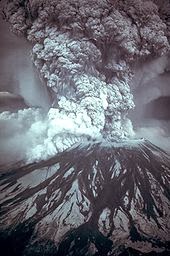
Eruption of Mount St. Helens on May 18, 1980, at 8:32 PDT.

         Hearing the curses from several students, I turned my back on the class—fearful still that someone might throw a knife—and printed their names on the chalkboard with a checkmark after each name.
         Turning back toward them, I said, “That’s for cursing. If you get two more checkmarks today, you’ll stay after school.” They groaned but said no more.
         To begin our new regime, I established a daily subject schedule. We’d pray, say the pledge of allegiance, and begin with religion. Following that, we’d study math, then reading, and so on.
         Before we began each subject that day, I distributed the textbooks for it and directed the students to open them to a section where their knowledge was weak. I’d learned their subject deficiencies from the quizzes I’d given on my first day in that classroom.
         As the day progressed, several boys sat like convulsive volcanoes ready to erupt. Throughout the day, I added checkmarks for anything that was on the list I’d posted that morning.


Mount St. Helens two years after the 1980 eruption.

         As I remember, by the day’s end, four boys—Ron, Bill, John M., and Tommy—and one girl—Jenny—had three or more checkmarks by their names. The five of them stayed after school. And subtracted. And subtracted. And tried to convince me they’d gotten to 0. And subtracted some more. The last student left the classroom nearly two hours after school ended. Fortunately, all five lived close by and could walk safely home.
         And so began the reign of Sister Innocence, tyrant of Mount Saint Scholastica Monastery.


Mount St. Helens, October 2009, 
with a view of the ice-covered crater rim.

(. . . to be continued next Wednesday, October 2)